

My attention was recently drawn to two real-world studies.
The first is coming from the Netherlands, published in the European Journal of Cancer. The full article is available here. In their work, Broekman et al. wanted to identify factors associated with not receiving systemic therapy in patients diagnosed with metastatic pancreatic adenocarcinoma in the Netherlands between 2015 and 2023.
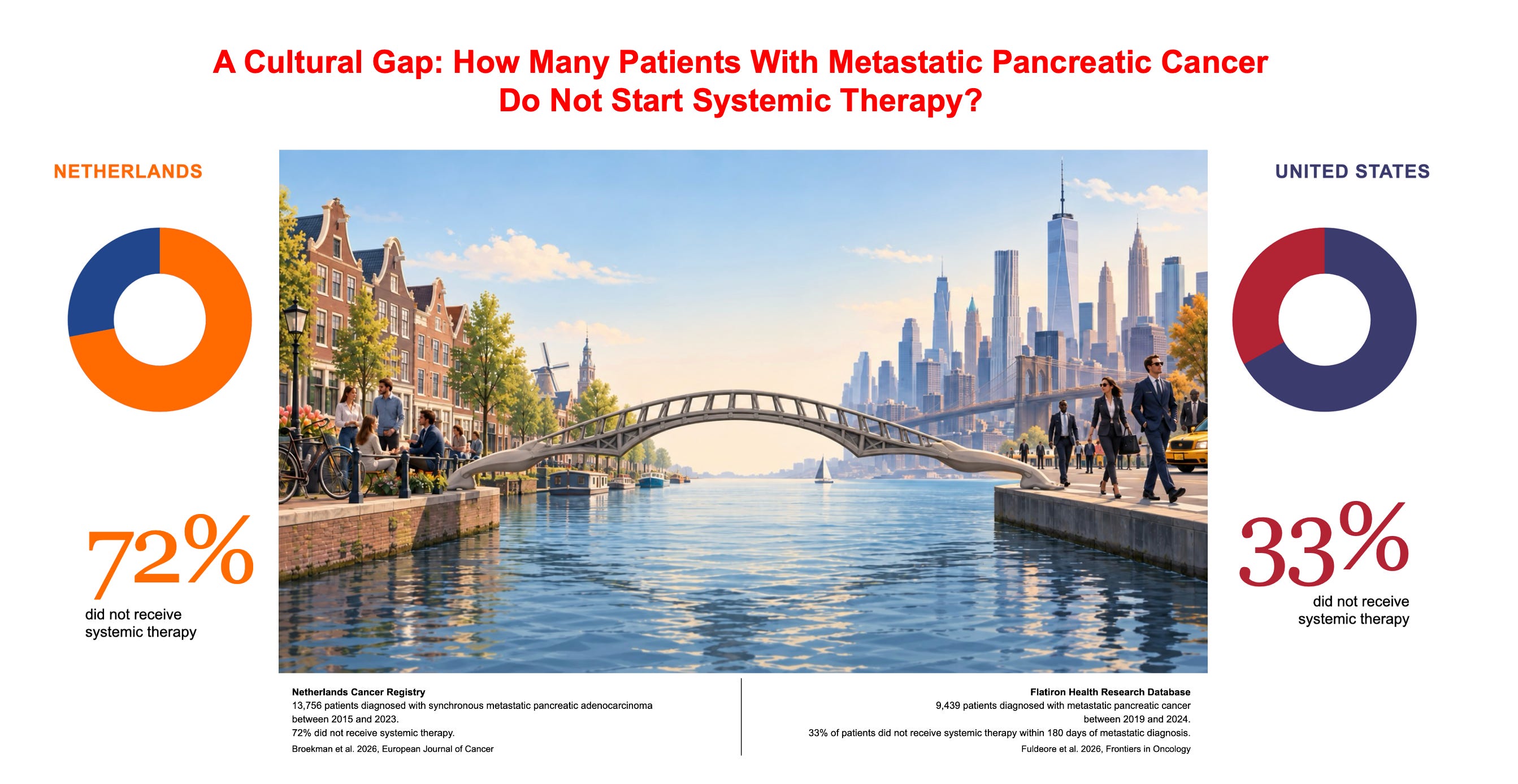
The most striking finding : 72% of patients did not receive any systemic therapy, mostly based on patient and family preference (39%).
Other results were nicely summarized by Thor Halfdanarson, a medical oncologist at Mayo Clinic:
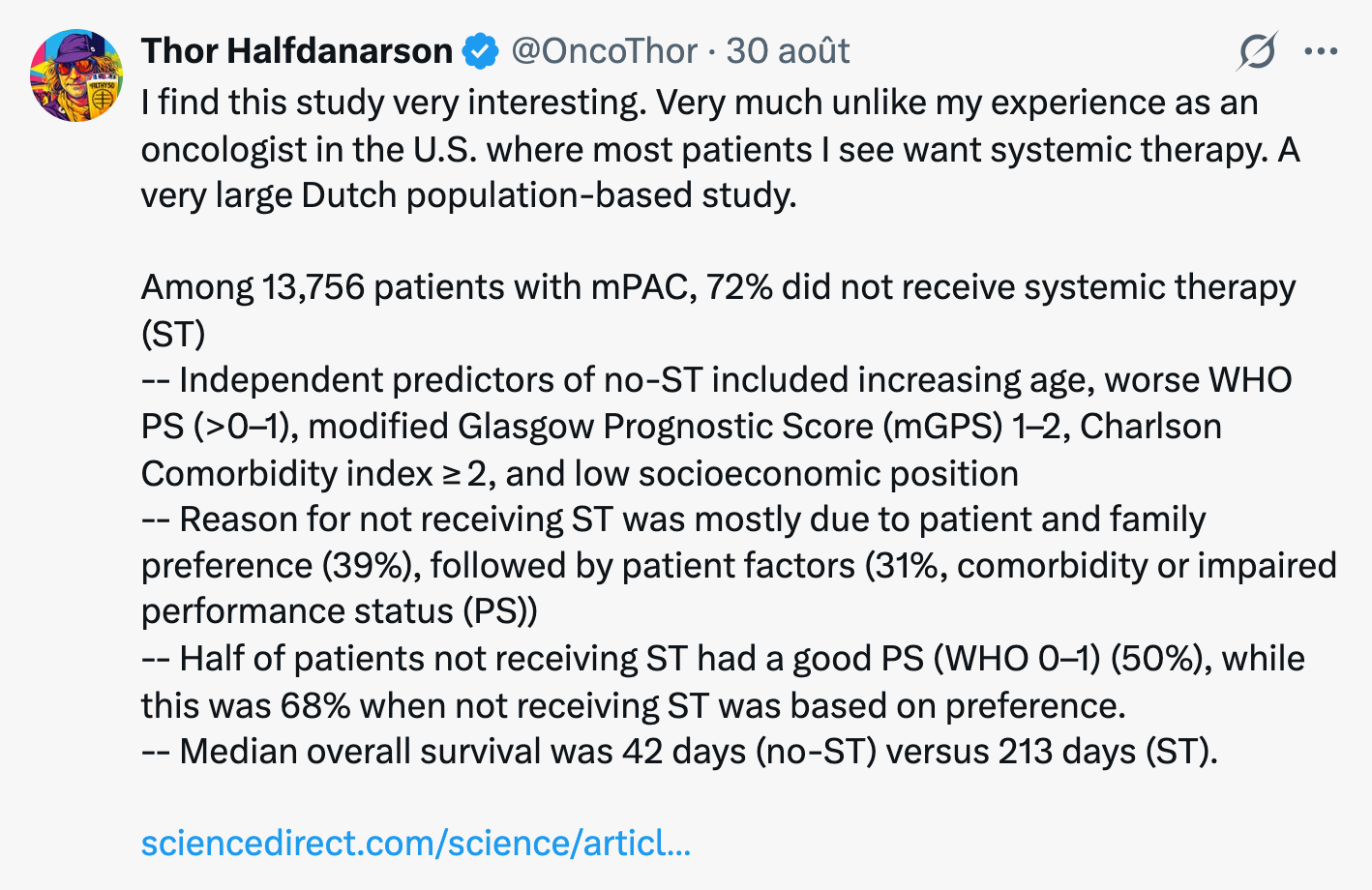
Reactions
The reactions on social media mostly highlighted that such pattern was the opposite of in the USA.
Thor Halfdanarson : “Very much unlike my experience as an oncologist in the U.S. where most patients I see want systemic therapy.” and the following conversation with a patient / advocate, Jud Kimmel:
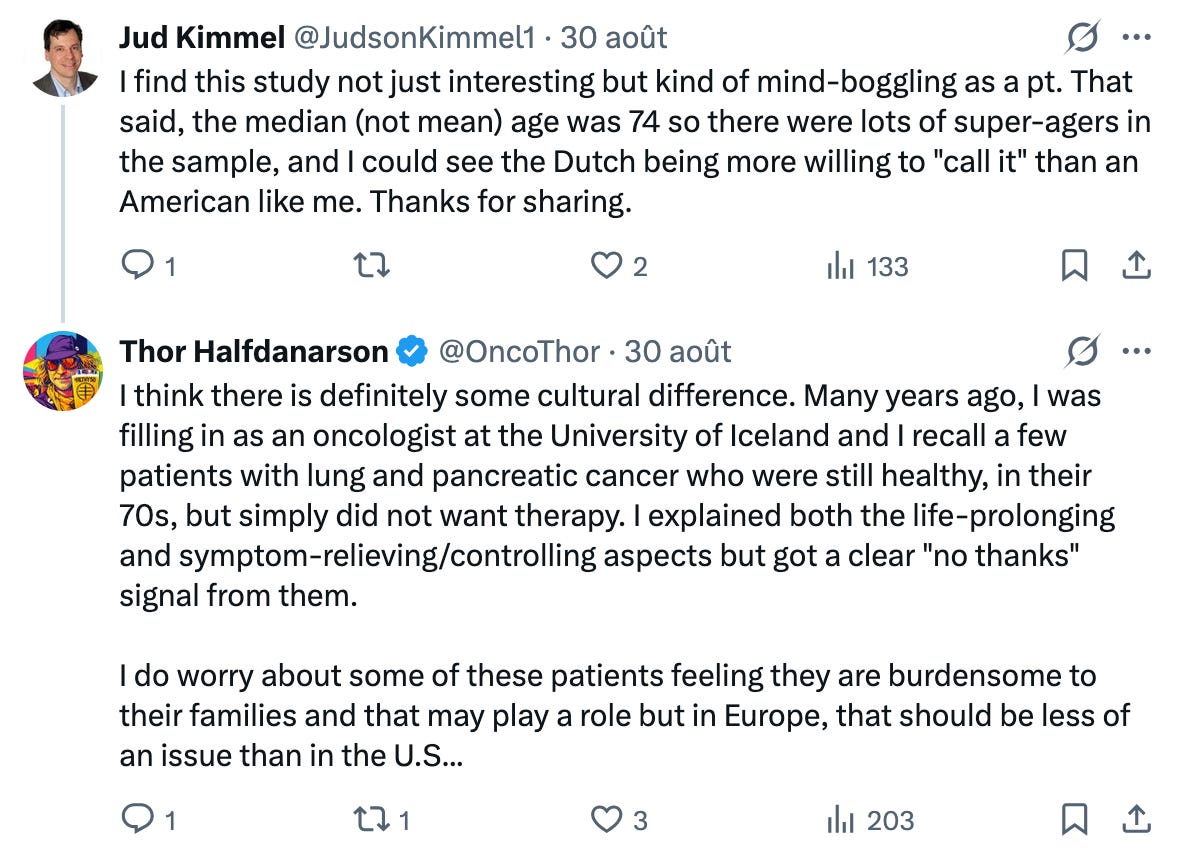
Personal experiences, coming from an oncologist and a patient / advocate, are highly valuable. But caution is needed before drawing broad conclusions. In many places, patients who decide not to undergo chemotherapy may never meet a GI oncologist, whose clinical experience is therefore based on an already selected group of patients. Similarly, a patient advocate may have more contact with patients who are highly proactive in managing their disease and treatment than with those who choose not to pursue that path. For these reasons, it is important to look the actual data.
Flatiron Health US Data
The second report that caught my attention was also published recently, where Fuldeore at al. conducted a comparable study in US patients diagnosed between 2019 and 2024. In short, they found an opposite pattern with a minority of 33% of patients not receiving systemic therapy, confirming the thoughts expressed on social media.
Survival benefit facing patient’s preference
Systemic therapy can prolong survival in metastatic pancreatic cancer, and for many patients this additional time is highly valuable. But survival is not the only outcome that matters.
Puting aside the many limitations potentially affecting quality of life results, even when a study shows preserved or improved “quality of life,” this does not necessarly capture everything patients may value. Quality-of-life questionnaires may not fully reflect the wish to avoid treatment altogether, preserve a sense of normality, reduce hospital visits, remain independent, or avoid the possibility of spending precious time with treatment-related toxicity.
As oncologists, we should therefore be cautious not to judge these choices. One patient may accept substantial toxicity for a chance of living longer; another may prioritize comfort, autonomy, or time-free from medical treatment. Both choices can be reasonable.
These data challenge an implicit assumption in oncology: that more life is necessarily better. Living longer is not always the same as living better, and “better” can only be defined by the patient.
My father's death, at 69, from a nursing mistake/systems error, the first time he ever went to hospital, in someone who had effectively never had a sick day in his life, was shocking (I was 15yo at the time) and a tragedy. My mother rotted in a nursing home with dementia for the last 8 years of her life, dying at 79.
Whose death do I want? My father's. I'd far rather die fit and healthy, when my death is a tragedy, than become debilitated and delirious/demented like most of the gen med patients on my ward. I don't understand this obsession with living as long as possible, when that usually means eking out the last few years with ever increasing disability and dependence.
But hey, in Australia, I'm a unicorn. Most families are desperate to keep their demented relatives alive as long as possible. Me, no. Not my relative (I chose not to give my demented mother the COVID vaccine, on the grounds that life prolonging measures weren't in her best interests) and not me.
Excelente. Gracias.