


We have all heard the powerful marketing phrases “chemo-free” and “targeted therapy.” They sound modern, precise, and less toxic. Regulators are willing to grant accelerated or conditional approvals on the basis of response rates for such therapies. Clinicians are relieved to have seemingly better news for their patients.
After all, who looks forward to getting chemotherapy?
And payers face pressure to reimburse these apparently superior treatment options.
Yet, despite how modern, gentle, and sophisticated terms such as “chemo-free” and “targeted therapy” may sound, they do not automatically mean better outcomes or safer treatment.
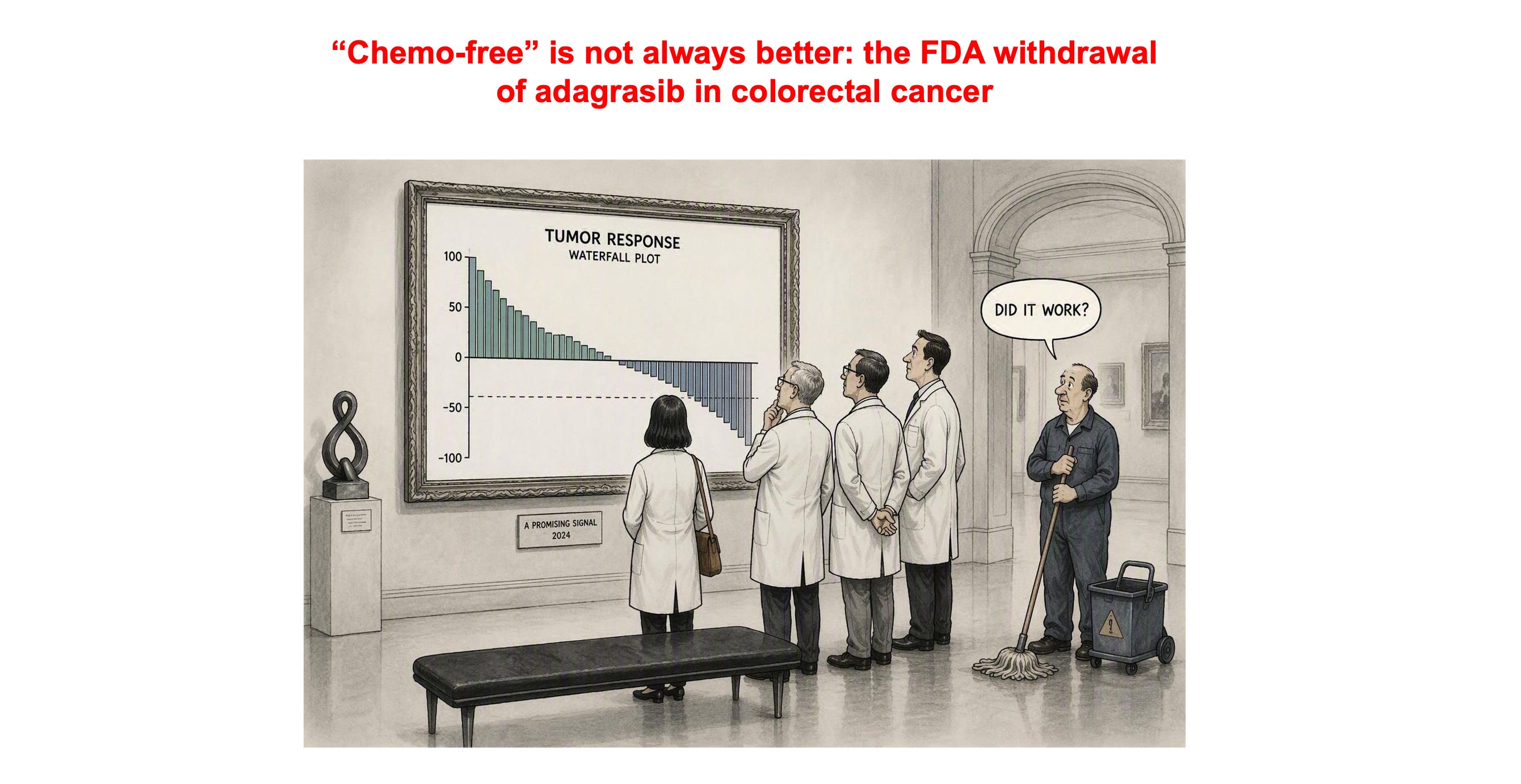
Response rate is not the same as clinical benefit
A high objective response rate can be impressive on a scan, but it does not guarantee longer survival or less toxicity. One recent example is the FDA’s withdrawal of adagrasib for KRAS G12C-mutated metastatic colorectal cancer.
The drug had initially received accelerated approval for use in combination with cetuximab through Priority Review and Breakthrough Therapy Designation, based on results from the single-arm KRYSTAL-1 trial. In the subsequent phase 3 study, KRYSTAL-10, the same regimen demonstrated a substantially higher objective response rate than chemotherapy (approximately 47% vs 16%). However, despite this impressive effect, there was no improvement in progression-free survival or overall survival.
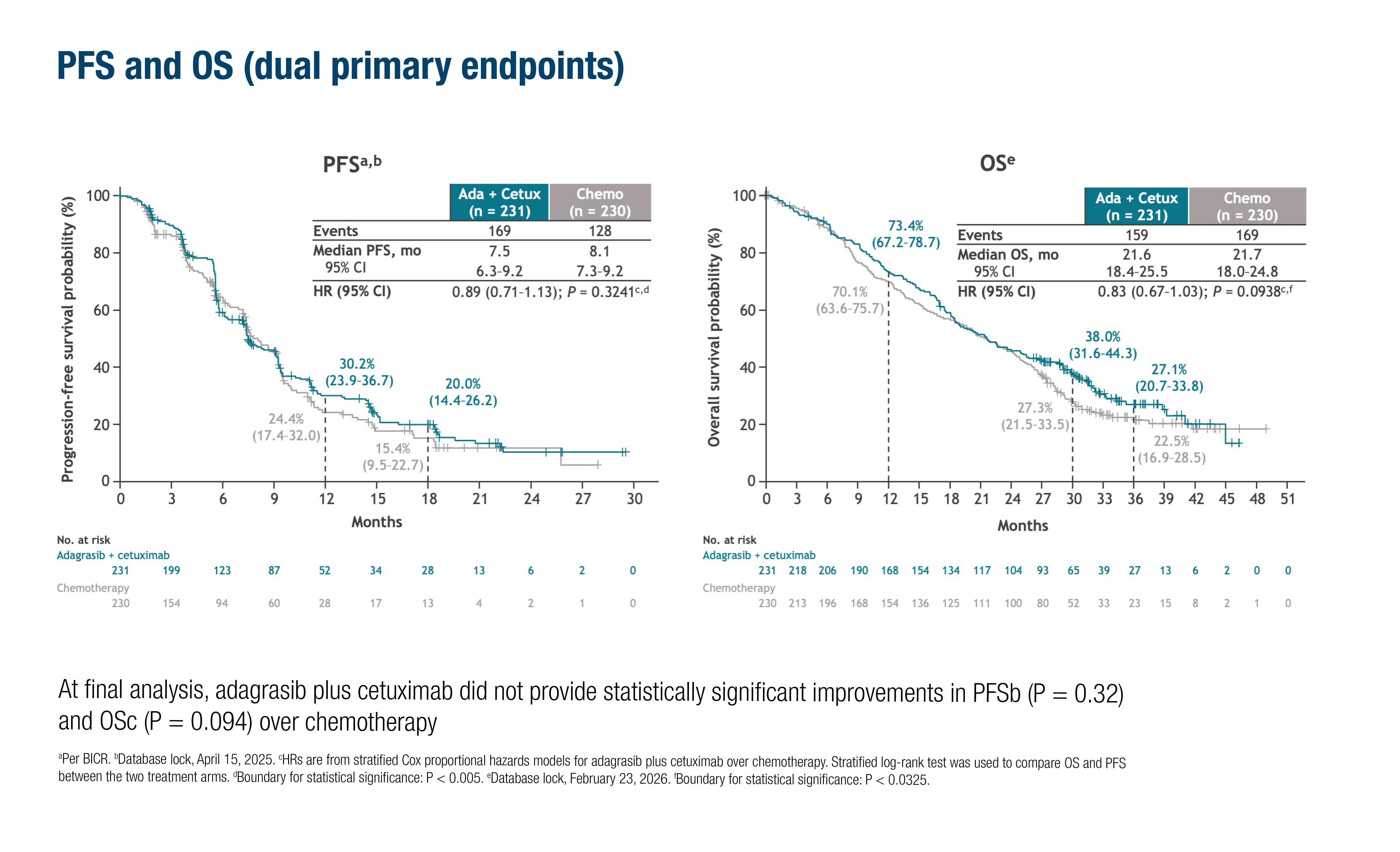
Based on these results, the FDA withdrew its approval on September 1, 2026, more than two years after the initial approval.
Other drugs and indications
Adagrasib and sotorasib in Non-Small-Cell Lung Cancer
The adagrasib story in colorectal cancer is not unique. When adagrasib was first reviewed for non-small-cell lung cancer, the EMA rejected the application, concluding that the available evidence was insufficient to demonstrate a major therapeutic advantage and that the benefit-risk balance remained uncertain.
After re-examination, adagrasib was eventually granted a conditional marketing authorisation. But even then, four CHMP members disagreed with the approval. In line with the concerns raised during the initial EMA review, they pointed to emerging data from the randomised CodeBreaK 200 trial with sotorasib, another KRAS G12C inhibitor, and questioned whether the level of activity seen with adagrasib was likely to translate into meaningful clinical benefit for patients.
CodeBreaK 200 had failed to demonstrate an overall survival benefit, though it met its primary endpoint with 1.1-month improvement in progression-free survival (5·6 vs 4·5 months). Nevertheless, several limitations of the trial raised doubts about the robustness of this 1.1-month difference. These included the choice of control arm, substantial dropout in the chemotherapy group, investigator bias and crossover between treatment arms, as well as differences in imaging assessment intervals that may have favoured sotorasib (see FDA Briefing Document, Jiang et al. and Olivier et al.).
Last year, the randomised phase 3 trial of adagrasib versus docetaxel in KRASG12C-mutated non-small cell lung cancer (KRYSTAL-12) also showed no overall survival benefit and only a 1.7-month progression-free survival advantage (7·2 vs 5·5 months). Also, these results remain uncertain because early dropout was considerably higher in the docetaxel arm, which may have affected the progression-free survival analysis.
Grade 3 or higher treatment-related adverse events occurred in 47% of patients treated with adagrasib and 46% of patients treated with docetaxel.
Sotorasib in KRAS-Mutated Colorectal Cancer
CodeBreaK 300, which evaluated sotorasib plus panitumumab versus investigator’s choice of trifluridine-tipiracil or regorafenib also showed no overall survival benefit and only a 1.7-month progression-free survival advantage (5.6 vs 3.9 months). Nevertheless, also here, concerns were raised about the robustness of the findings due to informative censoring, with substantially more patients censored early in the control arm, potentially affecting the progression-free survival analysis.
Conclusion
The examples above show why we should be careful with early signals. A waterfall plot can look impressive, and high response rates can create enthusiasm, but they should not be confused with proven clinical benefit.
The real test comes in well-designed randomised confirmatory trials against the standard of care. These trials should be adequately powered to assess survival and include standardised patient-reported outcomes to answer the question that really matters: does a treatment that looks promising actually help patients live longer, live better, or both, compared with the existing alternatives?

Can informative sensoring for PFS be excluded? The control arm looks quite affected. (You must have studied this Olivier :-) )
Thanks. Naive question: should the FDA grant or take away approval based on efficacy? I get it for safety but why not let docs decide efficacy? I can see that reimbursement should be based on two phase III trials, as people should not pay for drugs that do not work. But approval (or not) for efficacy seems to be heavy handed