


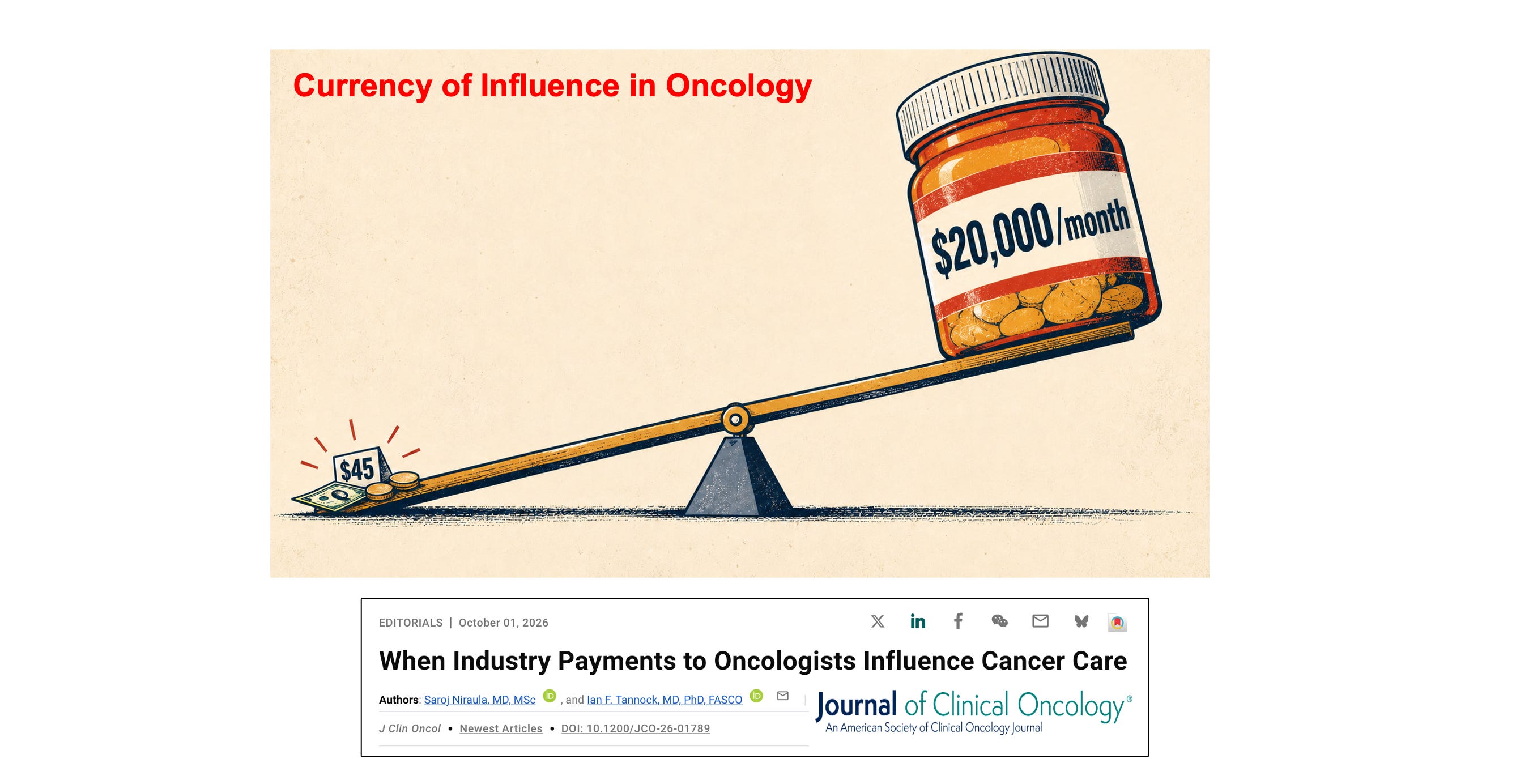
In today’s guest post, it’s my great pleasure to welcome Saroj Niraula, who recently commented, together with Ian Tannock, on a JCO study by Aaron Mitchell and colleagues showing how payments as small as $45 are associated with prescribing decisions involving cancer drugs. And anti-cancer drugs can cost tens of thousands of dollars per month! Timothée
Ask oncologists whether they would change a cancer prescription because a pharmaceutical company bought them dinner. Almost everyone would say no. Most would probably even find the question insulting. Now consider what researchers found when they examined actual prescribing behaviour.
In a recent Journal of Clinical Oncology study, Aaron Mitchell and colleagues found that oncologists who received payments from pharmaceutical companies were more likely to prescribe treatments marketed by those companies. The association was apparent whether the promoted treatments were preferred or nonpreferred under clinical guidelines. It also became stronger as payments increased (see figure 1).
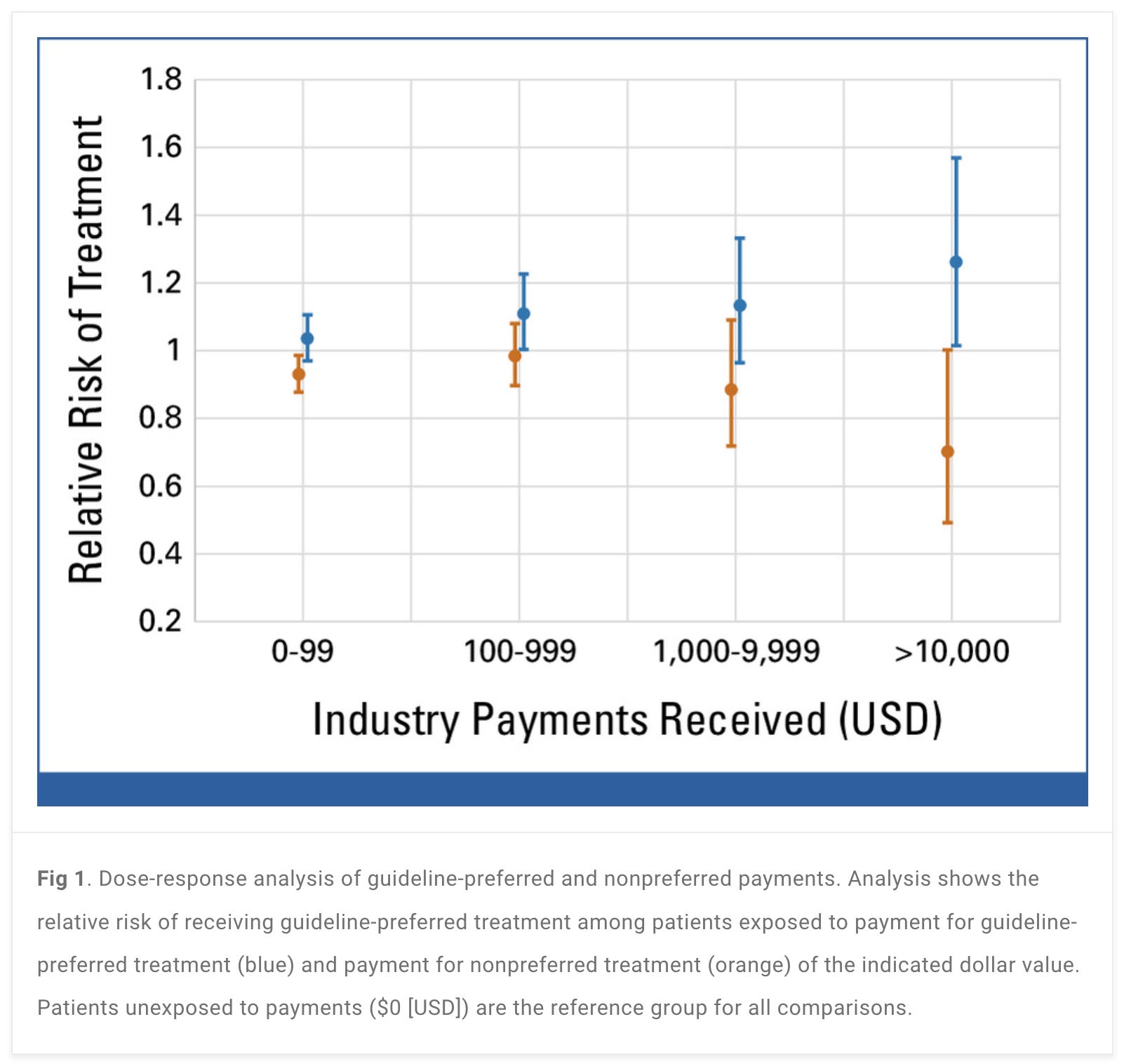
The median payments were just $45 and $61, respectively for guideline preferred and guideline nonpreferred treatments.
Think about that: we are talking about highly trained physicians making decisions about treatments that can cost tens of thousands of dollars every month. Their prescribing patterns were associated with financial relationships involving amounts that most oncologists would have no issue comfortably spending on lunch or dinner.
We discussed these findings in an accompanying Journal of Clinical Oncology editorial which I will summarize here.
Pharma understands human behaviour rather well
Pharmaceutical companies spend extraordinary amounts of money promoting their products to physicians. A JAMA analysis estimated that US pharmaceutical companies spent $20.3 billion on marketing to healthcare professionals in 2016, including nearly $1 billion in direct payments for nonresearch activities.
There is evidence that this spending affects prescribing. In a 2017 JAMA study, researchers examined what happened when 19 academic medical centres restricted access to pharmaceutical sales representatives. Prescribing shifted modestly away from promoted drugs following those restrictions.
Such findings are especially revealing: by simply reducing exposure to marketing, prescribing behaviour changed.
How does marketing work on people who sincerely believe they cannot be influenced?
We tend to imagine that influencing a physician requires a substantial payment in exchange for a favour. Pharmaceutical promotion can operate far more subtly.
Imagine encountering the same drug repeatedly. You hear about it during a sponsored presentation. The venue is perfect. The message comes from well-dressed, eloquent and engaging speakers. Its trial results are discussed by a respected colleague. You see the drug again and again in a company-supported educational programme. Over time, the name becomes familiar. When you next face a relevant clinical decision, it comes readily to mind.
There is nothing mysterious about this. Familiarity influences human judgement. Repeated exposure can make information easier to recall and more comfortable to act upon. It is particularly relevant in oncology, where several treatment options may be considered reasonable despite limited comparative evidence.
Pharma does not need a physician to abandon their professional ethics. A modest shift in prescribing probability, multiplied across thousands of decisions can be commercially valuable. And the physician can remain completely convinced that the choice was their own.
There is a reward more intoxicating than an honorarium
Money is only one part of the story. For an academic oncologist, recognition alone can be a powerful incentive. An invitation to speak at an international conference carries considerable professional value. So does being approached by a major company as an expert in a particular disease. Pharmaceutical companies can also offer access to research opportunities that help establish academic prominence. That prominence may lead to greater influence over how a treatment is understood and used.
Not every industry invitation is an attempt to manipulate a physician, nor does recognition automatically compromise judgement. The concern is what happens when academic success becomes closely connected to the commercial success of a treatment.
The same can occur in the absence of financial relationships, and we have argued that nonfinancial conflicts of interest deserve greater attention. For instance, a clinician who has invested years developing a drug may become deeply committed to its clinical value, even in the absence of financial motivations. The more publicly that position has been defended, the harder it may become to reconsider.
The ultimate prize: a physician who influences other physicians
The implications become more serious when influential experts, heads of departments or disease-sites, help determine how the rest of us practise oncology.
In a recent European Journal of Cancer article, we argued that conflicts become especially consequential when physicians are given the authority to interpret evidence for others. We need to be much more discerning about whom we choose to exercise that authority.
Consider a new cancer drug that improves progression-free survival by a few months, with uncertain effects on survival, high cost, and possible compromise in quality of life due to toxicities. A respected oncologist presents the result as a major advance. The treatment features prominently in educational sessions. Eventually, it becomes part of routine clinical practice.
Who decided that the magnitude of benefit justified such enthusiasm? Often, the answer lies in “expert interpretation”. And some of those experts have substantial financial relationships with the companies whose products they evaluate.
Disclosure has become a comfortable ritual
Anyone who regularly attends oncology conferences knows the familiar disclosure slide. Sometimes it contains so many pharmaceutical company names that reading them would consume the entire allotted time. The speaker displays it briefly and moves on to discuss the clinical evidence.
Disclosure is necessary, of course. But declaring an influence does nothing to eliminate it. We have somehow come to regard this as satisfactory conflict-of-interest management. But what protection does the audience actually receive?
Would patients be reassured to learn that the person recommending their treatment has financial relationships with its manufacturer, provided these are listed on a slide?
We should stop confusing marketing with scientific collaboration
Whenever restrictions on industry payments are proposed, someone inevitably warns that pharmaceutical innovation depends on collaboration with physicians.
Of course it does.
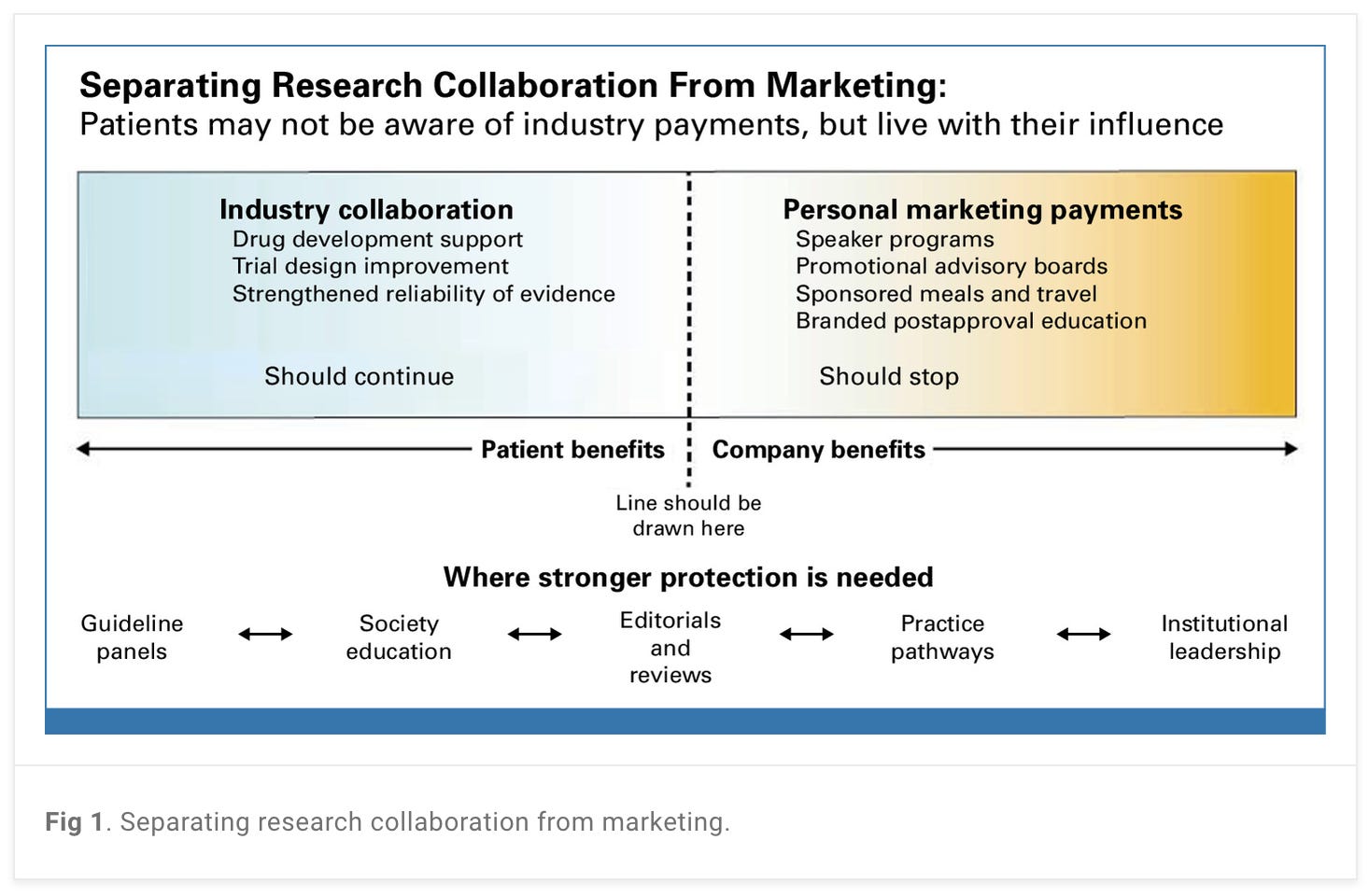
Academic oncologists have an important role in developing new treatments and improving clinical trials. Industry-funded research has delivered extraordinary advances in cancer care. We should encourage productive collaborations that generate reliable evidence and improve outcomes for patients.
But it is difficult to see why developing a better cancer treatment requires the same physician to participate in promotional speaker programmes. We should be willing to acknowledge that distinction.
Academic societies should place meaningful restrictions on personal promotional payments, particularly for members who develop guidelines and oversee professional education. Journals should be more selective about commissioning interpretive articles from authors with relevant financial relationships. Institutions should provide independent education rather than relying on companies to organise it.
These are practical steps. They would preserve the valuable contributions of industry to drug development while reducing avoidable commercial influence over clinical decisions.
This is the key figure from our editorial, where we clearly outline the differences between collaration and marketing.
Who pays the price?
Perhaps the most uncomfortable aspect of all this is that the patient is absent from these arrangements.
The company pays for a meal or sponsors an educational event. An influential physician receives professional recognition. A guideline panel recommends a treatment. The oncologist in the clinic makes a prescription. The patient only sees a trusted professional offering medical advice.
Cancer patients already face enough uncertainty. They should be able to trust that the recommendation they receive has been insulated, as far as reasonably possible, from commercial promotion.
I do not doubt the sincerity of oncologists who believe they are immune to such influence. That confidence is precisely what makes the problem difficult.
However, as shown repeatedly, financial relationships are associated with prescribing behaviour. Similarly, we have evidence that restricting promotional exposure can change prescribing. How much more evidence should we require before reconsidering arrangements that offer no indispensable benefit to patients?
The next time a pharmaceutical company offers us a dinner, a speaking invitation, or a promotional advisory role, we should ask ourselves two questions: Why is the company making this offer? And what makes us so confident that we cannot be influenced?

Simply eliminate all forms of payment from Pharm industry to health care researchers and providers...period.