


Most of the time, we never get much further than the back cover of a book. Life is busy, and there are simply too many books to read. The same goes for scientific papers. We often stop at the abstract. There are simply too many publications and too little time to read them all. But every now and then, it’s fun to go through the whole paper and read it as a clinical assessor.
If you decide to read a paper, and you’re the kind of person who enjoys detective stories, I challenge you to pick a paper on a combination of drugs. Look at the trial design, the patient population, the subgroup analyses, the control arm, and the quality-of-life data.

Why does contribution of component matters?
In oncology, we are seeing more and more combination therapies, which is not surprising given the heterogeneity of cancer. But perhaps one of the most overlooked questions is what regulators call “contribution of component.”
If Drug A and Drug B are given together, how do we know Drug B is actually adding value?
This is not just an academic question. It is even a moral one. You are exposing patients to additional toxicity. And in publicly funded healthcare systems, you are substantially increasing healthcare costs. Surely that should be justified.
Yet without the right trial design, determining whether each drug truly contributes to the benefit of the combination remains surprisingly difficult.
You need to scrutinise the trial design
In our recent paper in the JNCI, we discuss trial designs for combination therapies (see Table 1). The design is not only important for understanding how much each drug contributes to the overall effect, but also for determining which biological subgroup benefits most from the therapy.
Unfortunately, trials designed by drug developers rarely answer this question, as answering it is often not aligned with their commercial interests. Instead, studies are typically conducted in broad patient populations.
When a trial is positive overall, there is often pressure to extend the conclusions to everyone enrolled. Yet a positive trial can mask an uncomfortable reality: the observed effect may be driven largely by a single subgroup. The problem is that subgroup analyses are often underpowered and difficult to interpret. As a result, we may end up treating everyone, even though only a subset of patients truly benefits.
Table 1. Trial designs for combination therapies.
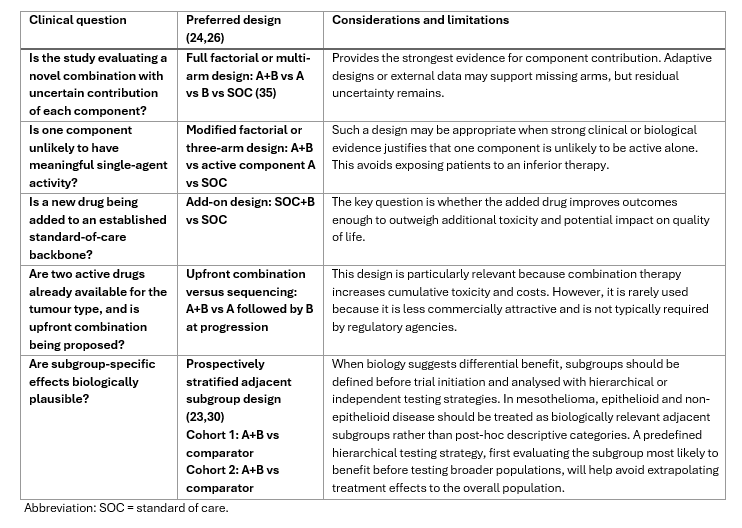
Are the biological subgroups prospectively defined and tested separately?
The best trial designs prospectively define and test biologically distinct patient groups separately. This may sound more complicated, and the common perception is that it requires larger trials and more patients. Ironically, the opposite can be true.
The MAGNITUDE trial in prostate cancer is a good example. By prospectively separating patients based on biological characteristics, the study was able to provide much clearer answers about who actually benefits from treatment. At the same time, it enrolled fewer patients than some of the seemingly simpler all-comer trials. In other words, a better question can sometimes require fewer patients, not more.
What happens after the trial?
Another thing that is often overlooked is what happens after the trial. If a combination simply brings first-line and second-line treatments together upfront, then what matters is not only whether the combination is better than the control arm during the trial. Patients in the control arm should also have access to the second-line therapy after progression. In this situation, the real comparison is not the combination versus a single drug. It is the combination versus sequential therapy.
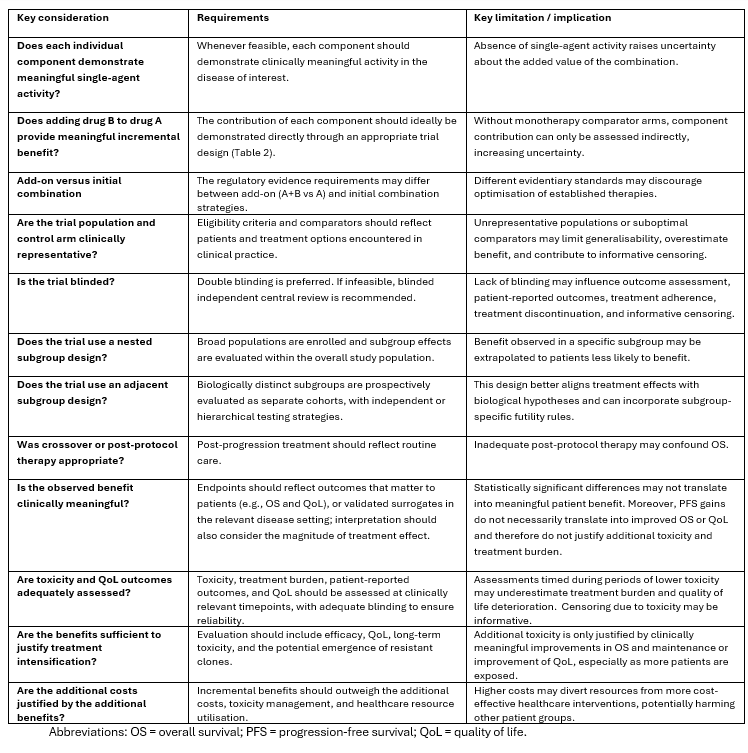
In our recent JNCI paper, we provide a simple set of questions to guide your assessment. Take a combination trial, keep Table 2 next to you, and work your way through the paper.
You may find that the most interesting part of the paper is not whether the trial was positive, overall. It’s whether each drug actually contributed to the combination, whether the endpoints are meaningful, whether the assessments were properly blinded to avoid bias, whether the added toxicity and costs are justified by the magnitude of benefit, and whether the trial design tells us who truly benefits from the therapy.
Table 2. Key considerations in oncology combination therapy trials
Read the full article for more insights, openly available here!
