Where Are the Patients Completing Quality-of-Life Questionnaires in PANOVA-3 ?
Tumor Treating Fields in Pancreatic Cancer
The phase 3 PANOVA-3 trial randomized 571 patients with locally advanced pancreatic cancer to TTFields plus gemcitabine/nab-paclitaxel or chemotherapy alone. Median overall survival improved from 14.2 to 16.2 months (HR 0.82; 95% CI 0.68–0.99), without significant improvement in progression-free survival (published here).
In a recent perspective, we raised concerns about the evidence supporting TTFields as a whole, particularly the lack of any sham-controlled trial. Regarding PANOVA-3 specifically, additional concerns included the suboptimal control arm and an unjustified change in sample size.
TTFields require wearing a device for at least 18 hours daily, with device-related skin adverse events reported in 76.3% of patients. So, when seeing a new publication concluding that TTFs improved quality of life in PANOVA-3, we decided to take a closer look, together with Alfredo Addeo, my head in the Oncology Unit at Geneva University Hospitals.

Prespecified analyses?
The publication presents itself, in the abstract, as a “prespecified secondary analysis”.
But what was actually planned? The original statistical analysis plan (SAP) specified descriptive reporting of QLQ-C30 and QLQPAN26 data during the first 12 months. Instead, the publication emphasizes analyses extending to 26 months, including deterioration-free survival and time to opioid use, neither included in the original SAP.
Only opioid use is explicitly labeled post hoc in the abstract. However, other analyses also depart from the SAP and should be considered post hoc unless their prior specification can be documented.
If we stick to the originally planned analyses, no statistically significant between-arm differences in global health status (QLQ-C30), pancreatic pain, or digestive function (QLQ-PAN26) were reported at 2, 6, or 10 months, the only available timepoints for the analyses originally planned in the SAP.
Bottom line: Whenever you see QoL results, check the original statistical plan first. What was planned, and what is actually being reported?
You need to be alive to complete a QoL questionnaire: Where did the extra questionnaires come from?
At 26 months, 68 patients in the TTFields arm reportedly completed QoL questionnaires (eTable 2). Yet, in the original PANOVA-3 publication, only 50 patients remained at risk for overall survival at 24 months.
How could 68 patients complete questionnaires at 26 months when only 50 remained at risk for survival two months earlier?
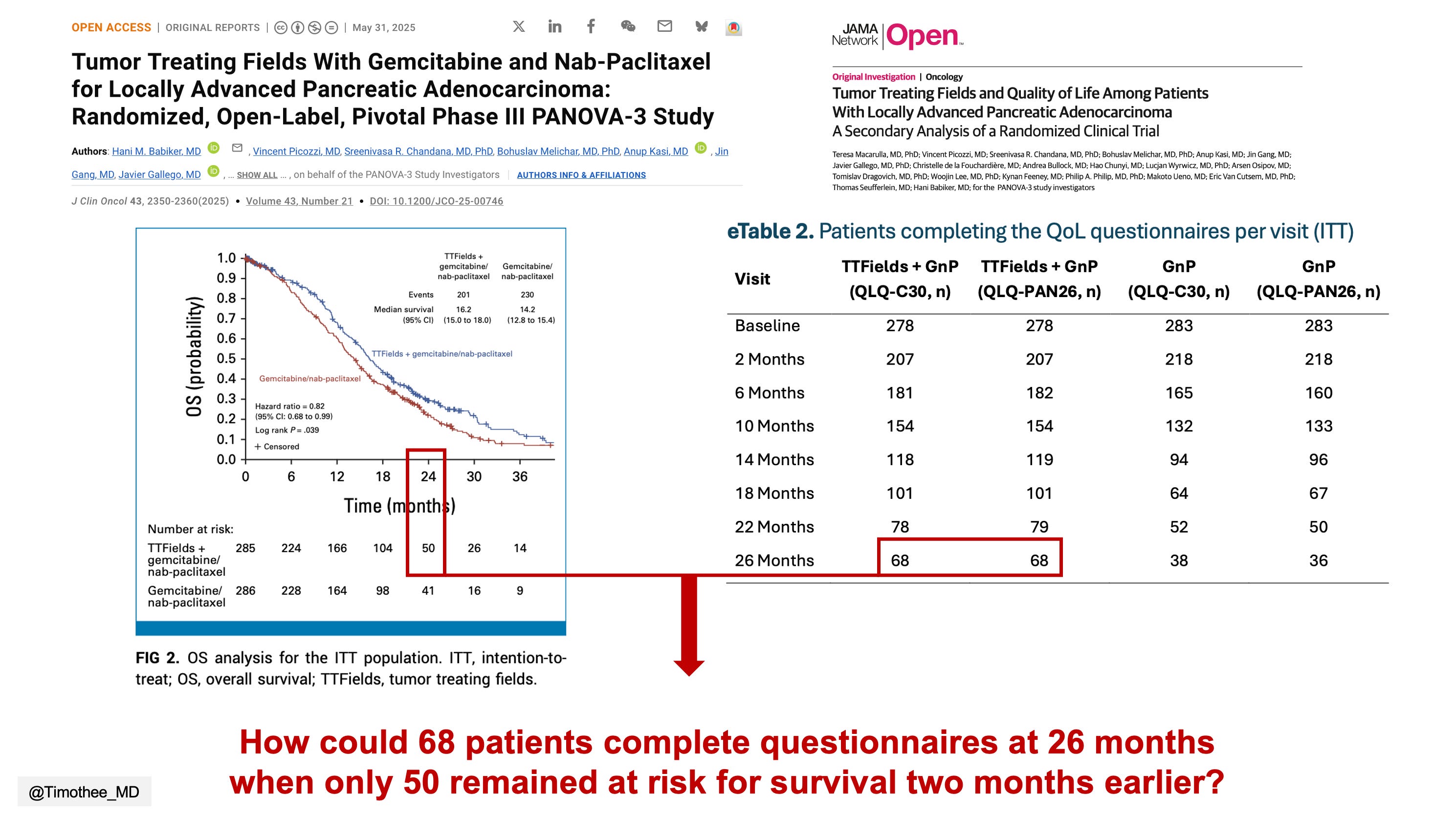
If a patient completed a questionnaire at 26 months, we know they were alive at that time: they should therefore still be at risk for survival at 24 months.
The survival and QoL analyses had a 2-week difference in data cutoffs (October 16 and October 31, 2024), which cannot explain the discrepancy.
Without clarification from the investigators, such findings raise serious concerns about the accuracy of the reported QoL data, and the PANOVA-3 trial data more broadly.
Too many patients censored for survival in PANOVA-3
Censoring occurs when a patient’s survival status is no longer known, or when follow-up ends before the patient experiences the event. While administrative censoring at the end of a trial is expected, early censoring for overall survival should be minimal: after all, determining whether a patient is alive or dead is generally straightforward, even after treatment discontinuation.
Using reconstructed individual patient data from the published survival curves, I estimated that 13.3% of patients in the TTFields arm were censored within the first 12 months (most, 10.9%, within the first 6 months!), compared with only 4.5% in the control arm.
Patients who discontinue follow-up because of toxicity or treatment burden may also have a worse prognosis. If these patients are disproportionately censored in the experimental arm, the survival benefit could be overestimated. This would precisely be informative censoring. In an exploratory sensitivity analysis, reclassifying just 10 early-censored patients in the TTFields arm as deaths was sufficient to remove statistical significance in our reconstructed dataset. (see below, also available at the BREAKING-ICE App, select “TTF-PANOVA-3-OS_reconstructKM”).
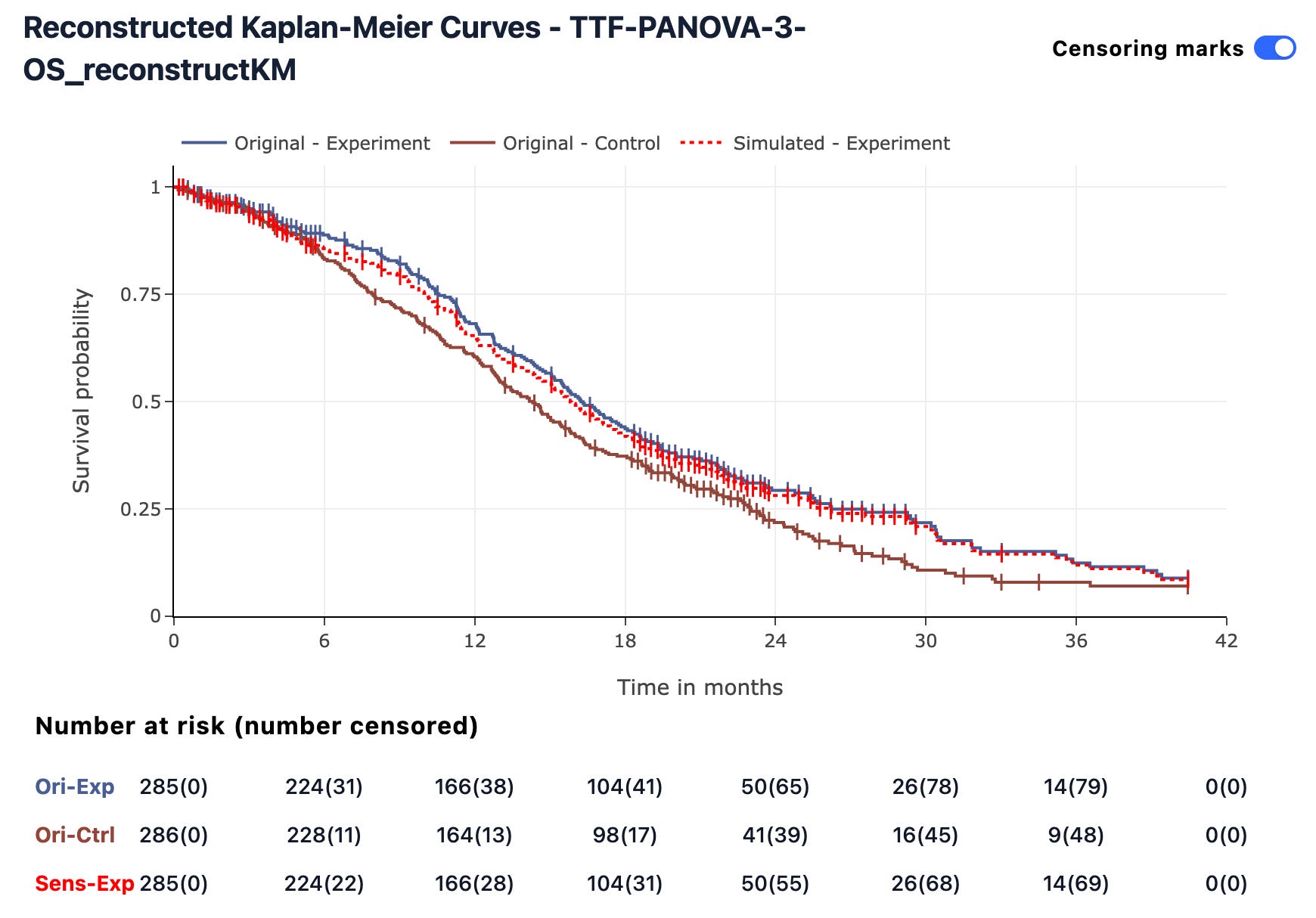
With such a high level of early censoring, particularly when the OS results were at the cusp of statistical significance (and without a PFS benefit), the robustness of the reported OS findings can be questioned.
How censoring in survival data affect quality of life results?
The mechanism of informative censoring may also affect QoL results. We already described this here and here.
In PANOVA-3, patients who left the trial may have done so because of toxicity or the burden of wearing TTFields, and therefore may have worse QoL. If these patients stop completing questionnaires, their poorer QoL outcomes would be missing from the analysis.
As a result, the remaining patients may appear to have better QoL, simply because those doing worse are no longer followed. In this case, excess censoring in the TTFs arm would artificially favor TTFields.
High and excess censoring in survival data in the TTFields arm raises concerns that missing QoL data may favor TTFields.
What next?
JAMA Network Open allows readers to submit online comments, and together with Alfredo Addeo, we have submitted one summarizing our concerns. Comments are usually posted within 48 hours, and we look forward to receiving answers to these important questions.
Quality of life data are of vital importance. Yet, QoL analyses can be difficult to appraise, and we are often less familiar with them than with efficacy analyses. Many issues can affect QoL results: missing data, limited duration of data collection, timing of questionnaire administration, spin, and many others. In other words, it’s easy to be misled by a QoL report.
When a more toxic treatment is reported to improve QoL, that alone should prompt scrutiny.
Discussion about this post